
Before You Buy the Story, Understand the Business
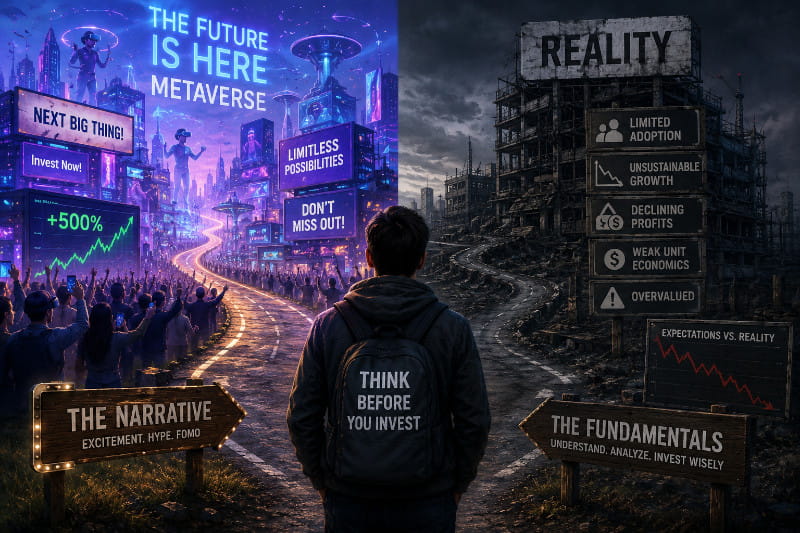
There was a period when financial news channels could hardly go a single day without calling the metaverse “the future.” Tech panels discussed these digital worlds as though they were inevitable and companies rushed to rebrand themselves around virtual experiences. Investors also poured money into anything remotely connected to the trend. For beginner investors watching from the outside and witnessing the trend firsthand, the excitement felt convincing. The narrative sounded too large to ignore. If this was truly the next phase of the internet, then investing early seemed like an obvious choice. What many people failed to notice, however, was the growing gap between the narrative and reality. Consumer adoption remained limited and businesses struggled to justify massive spending. Moreover, many companies attached to the trend were generating far more excitement than actual profitability. The headlines focused on possibility, while the fundamentals quietly told a different story.
The real danger for beginner investors is not a lack of intelligence, but something far more indirect: borrowed conviction. When the metaverse dominated headlines, many beginners invested not because they understood the businesses involved, but because the narrative sounded fascinating. Every news segment, analyst discussion, and social media post seemed to shore up the same message that this was the future. In that environment, it becomes easy to mistake popularity for understanding. A company receiving constant media attention can feel like a safe investment even when very few investors can explain how it makes money. The investors may also not know whether the company is profitable, has substantial earnings or if its products are gaining meaningful adoption. The rising stock price only adds to the illusion. As prices climb, investors often assume the underlying business must be getting stronger. In reality, the market may simply be reacting to excitement rather than fundamentals. The mistake is not believing in a promising idea, but rather it is believing that a coercive narrative can replace the work of understanding the business behind it.
When Excitement Replaces Understanding
What makes this mistake so common is that modern markets are remarkably good at creating a sense of urgency. Financial news operates in cycles that reward attention, not patience. Influencers compete to identify the “next big thing” before everyone else, while social media platforms exaggerate the strongest opinions and the most daring predictions. During the metaverse boom, it often felt as though every conversation pointed in the same direction. News channels discussed its possibilities and online communities celebrated companies connected to it. Moreover, investors feared being left behind if they did not act quickly enough.
This fear of missing out is a powerful force. It can make rising stock prices feel like evidence, even when they are merely a reflection of growing frenzy. We have seen similar patterns in meme stock rallies, where online excitement and social media momentum drove stock prices far beyond what the underlying businesses could reasonably justify, and in speculative technology booms, where companies experienced dramatic increases in valuation long before they exhibited sustainable profitability. In many cases, investors spent more time tracking daily price movements than understanding the businesses themselves. They knew where the stock had been, but not what the company actually did. They were also clueless as to how it generated revenue, or whether its long-term prospects justified the enthusiasm. When urgency takes over, the narrative often becomes more important than the substance, and that is precisely when costly mistakes are most likely to occur.
The challenge for investors is that headlines often tell a very different story from what is happening beneath the surface of a business. During the metaverse boom, media coverage focused heavily on future possibilities, creating the impression that success was almost guaranteed. Companies associated with the trend attracted enormous attention, soaring valuations, and widespread investor enthusiasm. However, many still faced fundamental challenges such as weak profitability, uncertain customer adoption, unsustainable growth expectations, and business models that had yet to prove their long-term viability. Similar patterns have appeared throughout market history, where packed IPOs, viral social media excitement, and ambitious projections generated optimism long before the lurking businesses demonstrated durable financial performance. For a while, hype can mask these issues, but eventually reality catches up. When expectations become detached from fundamentals, even the most fascinating narrative can lead to disappointing investment outcomes.
Looking Beyond the Narrative
Better investors tend to approach excitement with curiosity rather than urgency. Instead of immediately acting on a fascinating narrative, they spend time understanding the business behind it. During the metaverse boom, that might have meant looking beyond the headlines and asking practical questions. Are people actually using these products regularly? Is adoption growing organically? Does the company have a clear path to profitability? Rather than focusing solely on what the trend might become in the future, they pay attention to what is happening in the present. They observe how customers interact with products and question widely accepted assumptions. They look for evidence that demand is durable rather than temporary. This does not mean ignoring innovation or avoiding emerging trends. It simply means being mindful that a promising idea and a successful business are not always the same thing. In a market often driven by excitement and speed, the ability to slow down and think independently can be one of the most valuable advantages an investor has.
The metaverse boom serves as a useful reminder that the market often rewards excitement long before it rewards reality. For many beginner investors, the temptation was not irrational—the narrative was fascinating, the coverage was constant, and the opportunity seemed too significant to ignore. Yet investing is rarely about reacting to the loudest story in the room. The market constantly pressures people to act quickly, to keep up, and to believe that everyone else has already discovered the next great opportunity. In that environment, patience can feel uncomfortable and independent thinking can feel lonely. The most dangerous investing mistakes rarely begin with bad intentions. More often, they begin with excitement, urgency, and the belief that a popular narrative is enough to justify a decision. Over time, however, the investors who tend to fare best are not necessarily those who move first, but those who take the time to understand what lies behind the story.